Sunday, October 28, 2018

Role of Pre-Assessment


Why Pre-Assess?
-Gives the instructor knowledge regarding what the students know and what they need to work on.
-Gives the instructor a good base as to where to start with the lesson and their students.
-Helps the students get a general idea of what will be taught in the lesson and what they are going to learn. 
-Helps students recognize their improvement from the beginning of the lesson to the end.  Comparing the pre-assessment and the final independent practice will show the students growth. 

Image result for science thinking cartoon
Why is it important to learn about your students?
-In order to connect with your students, the teacher must know their strengths and weaknesses.
-The teacher must know what they need to work on with each student to further their growth in their classroom.
-Teachers have to have an understanding of what their students are misunderstanding/ their misconceptions to be able to address and correct.
-Teachers need a strong foundation with their students to succeed.  When students are comfortable with their teacher, they will want to further themselves and push their efforts to their fullest potential. 

Reflection: Field Work


Related image

Understanding of student learning:
In the classroom, each child learned differently and at different speeds.  Some children needed more attention then others.  Each teacher had to help them focus and stay on task.  It is important that each lesson can connect with each student in the classroom.  Therefore, each lesson needs to contain different ways of teaching including direct instruction and inquiry.

How students learn:
Students connect with the direct lesson and the inquiry lesson on different levels.  The direct lesson plan is geared towards students who are able to maintain their focus and interest while being taught.  The note packets help the students that have a harder time staying focused follow along with the information.  The guided practice in the direct lesson plans help the visual learners connect their thoughts and new information.  The inquiry lesson helps the students that need a hands on approach.  This is interactive and can help students that may not collect everything that was taught in the direct lesson.  

How this experience helped my understanding of teaching science:
Before this experience, I had no background knowledge of teaching science.  I learned new approaches to teaching such as direct and inquiry lessons.  Inquiry lessons were really new to me.  I also was able to get an idea of what students like and dislike.  The inquiry lessons seem to always have a positive impact on the students.  They were fun and interactive which made it easy for the students to focus while learning and exploring.  The inquiry lessons also help the students gain and test their knowledge on the scientific method.

The 5 Groups:
I felt that each group did a great job with their topics and presenting their information.  All of us are learning and getting our feel for the field.  Each group had different teaching styles and I felt that every group was successful and learned a lot.  Students seemed to be very excited during all of the inquiry activities.  They loved the hands on approach and being able to research their hypothesis.  I also think the students were excited during the guided practices and animations/videos in the slides.  I felt that the students often became distracted during the direct lesson presentations for every group. The students would get bored listening to information for a long period of time but the note packets definitely helped with their focus.

Reflection: How to teach in general:
This experience helped my teaching style overall in many ways.  I learned how to approach new topics that the students are unsure about, using guided practice and independent practice, and I will be able to apply these new methods to my teaching style.

Discoveries about yourself:
I learned a lot about myself in this experience.  I learned my strengths and weaknesses.  My strengths being confidence in front of a class, strong teacher voice, and being able to present information to the students in a successful way.  My weaknesses include saying guys!! I was able to further develop my teaching knowledge and approaches that will help me in the future.  


How will this impact your future teaching of science in my own classroom:
This will greatly impact my future teaching of science in my own classrooms.  I will be able to utilize direct instruction with a new topic that my students are unfamiliar with.  I will then construct an inquiry lesson regarding the information provided in the direct lesson.  The inquiry lesson will be fun and interactive for the students to complete.  I will switch often between group inquiry lessons and individual inquiry lesson.  The class will then share their findings and further their research.  I can't wait to take my own approach to teaching science in my own classroom! 

Mystery Bag

Image result for mystery bag


Mystery Bag Activity
  • What comes to mind when you look at the bag?
  • What questions do you have about the bag?
Each person then has 5 seconds to handle the bag and gather information
Guesses:
  • rattles
  • soft
  • squishy
  • squeaks
  • ball
  • dog or baby toy?
Categorize:
  • formulated a statement: what you think is in the bag (hypothesis)
  • hypothesis- tentative explanation
  • create a method to obtain information
  • How do we figure it out
  • two possibilities: the hypothesis is correct, the hypothesis is incorrect
  • restate the hypothesis
  • will not prove but support
  • have to test several times to prove
  • the more test results, the more results
  • hypothesis- not a guess, a tentative explanation for the problem/question based on some type of observation
  • Have to support hypothesis!!
Actually in the bag:
  • rattle
  • rock
  • softball
Why we need to use inquiry in science:
  • No direct answers in science because science is always evolving. 
  • Principle concept: scientific knowledge is fundamentally uncertain
  • Science is uncertain because it is a human activity
  • Science explanations seem less certain when they are based on indirect information
  • Scientific uncertainty can be reduced through collaboration
  • the scientific argument is based on justified evidence
Why this activity?
  • Stimulates creativity
  • Develops creative thinking
  • Helps students understand the scientific method
  • Gives students a better understanding of a hypothesis

Sunday, October 21, 2018

FIELD WORK: Group 5 Inquiry

Group 5: Inquiry Lesson
Image result for biomes cartoon
Group 5 presented their inquiry lesson to the class today.  This was one of my favorite lessons that I have seen during our field work time.  The teachers prepared a review of what was previously taught and their problem.  They created Mrs. Smarty Plants.  I thought this was adorable!  Mrs. Smarty Plants had gone to each one of the different biomes and collected tons of research but unfortunately lost her findings.  It was the students job to help Mrs. Smarty Plants collect new research about each biome.  The teachers then set up a station, each with a different biome.  The station included a book or two on the biome and the iPad with a few articles for the students to look through and collect data. The students loved this activity.  I thought the use of multiple resources was a great way to really portray the research method.  The group did a great job during this lesson.  

FIELD WORK: Group 5 Direct

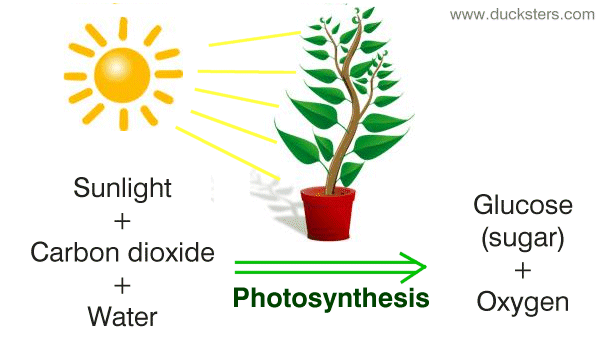
Image result for photosynthesis
Group 5: Direct Lesson
Today in field work, group 5 taught the 4th grade class about photosynthesis and how plants survive in different environments.  I feel this is one of the more important lessons that should be taught about plants.  It is the essential key to a plants life.  This group did a great job of getting the information to the students.  The group also had several interactive activities throughout the lesson.  The kids seemed to LOVE this style.  Students need to be able to get up and out of their seats during a lengthy lesson.  The group taught the process of photosynthesis and how the plants survive in the four different biomes.  The group also taught the key details of each biome and their environments.  This was a fun topic!  If I could have picked one, this would have been my choice.  

FIELD WORK: Group 4 Inquiry

Image result for alien cartoon


Group 4: Inquiry Lesson


Today was our inquiry lesson!  We had a rough start to our inquiry lesson idea but after creating a new base it seemed to go very smooth!  Before presenting the problem, we reviewed what was previously taught and the scientific method that the students would be using throughout the lesson.  The general idea of our inquiry lesson was that the students had to help our alien friend!  Our alien friend has just dropped down to earth and has no idea what these green things on the ground are.  It was the students job to go to each group and discover what plant is there and all the information that comes with that plant.  Each station had one teacher, a real plant (one of the four that were discussed in the lesson), and research articles.  The students received a packet that included a question sheet for each station.  They had to create a hypothesis, find three facts, and discover what plant they were dealing with.  At the end of the lesson, the class shared their findings with each other.  Each group discussed what they found and what plant was being represented.  After their discovery, the students were assigned to write a tweet to our alien friend telling him their findings and what plant was their personal favorite.  The students seemed to love the idea and going to each station learning more about the different plants.  Overall, I think we did a pretty good job! The group tried our best. 


FIELD WORK: Group 4 Direct

Group 4: Direct Lesson
Image result for plant classification
This was my time to teach the 4th grade students! Our objective was to teach the students all about plant classification.  We began the lesson by reviewing what was taught by the teachers before us.  We also went over classroom rules, our quiet method, our check for understanding methods and what we were going to teach.  Since it is almost Halloween, we used the spell "Hocus Pocus" and the students reply with "Time to Focus."  The students responded really well to this fun way of getting them to quiet down.  The students were each given a note packet that went along with the powerpoint presentation.  The note packet was fun and color coded.  Each one of the teachers in my group rotated throughout the slides.  For our guided practice, we had the students come up to the board and connect the correct term with the correct picture of the plant.  Our independent practice was a work sheet with a word bank and a few questions that went over the lesson we had just taught.  Our closure was a few questions that had been taught throughout the lesson.  We did this as a class and checked for understanding after each question.  Overall, I think our lesson went really well.  We provided a lot of information to the students and had fun teaching.  We also learned a lot and will apply it to our future!